


Description
Please be advised all Hokuyo components not in stock now have a 10-12 month lead time
- Supply voltage: 12VDC ±10%
- Detectable in Snowy, Rainy, Foggy and Dusty conditions
- Ethernet Interface
- Can be used Outdoors
- IP Rating: 67
The Hokuyo UTM-30LX-EW Scanning Laser Rangefinder is a small, accurate, high-speed device for outdoor robotic applications. This model uses Ethernet interface for communication and can obtain measurement data in a wider field of view up to a distance of 30 meters with millimeter resolution in a 270° arc. To ensure reliable measurement results in adverse conditions such as rain, fog, snow, or dusty environments, this device uses multi-echo technology for detection. It allows for receiving multiple reflected waves per transmitted laser pulse in order to obtain usable measurement data. The result is very reliable object detection and 2-D mapping of the environment in all weather conditions.
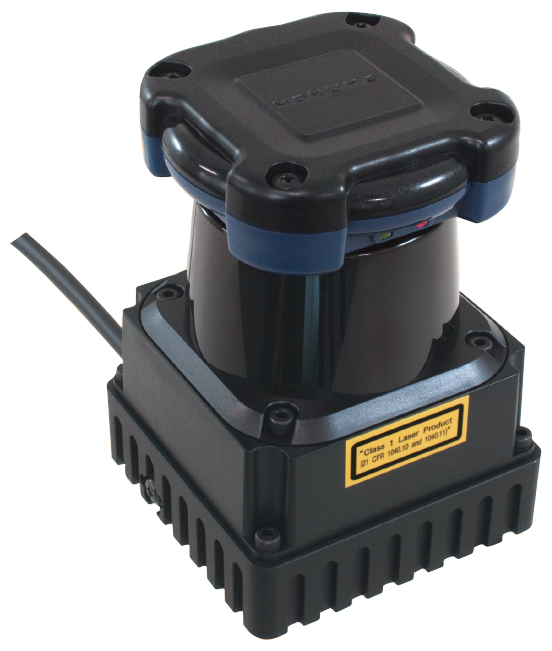
Features:
- Long Detection range: 30m
- Wide Angle: 270 Degree
- Outdoor Environment
- Compact and Light: W60 x D60 x H87 mm, 370g
- Multi-Echo Detection for Outdoor Applications
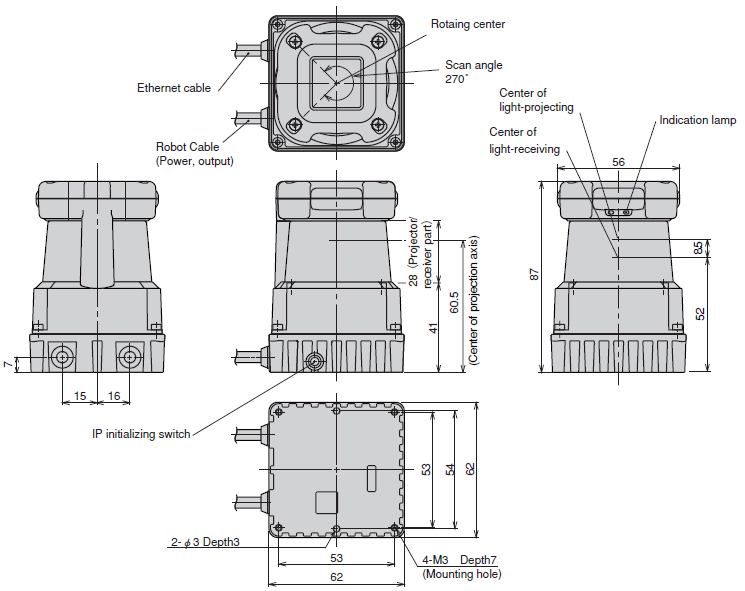
- Power source: 12VDC±10% (Current consumption: Max:1A, Normal: 0.7A)
- Consumption current: During operation: 0.7A or less, Start-up: Max. 1A
- Principle: Direct Time of Flight
- Light source: Semiconductor laser diode (?=905nm) Laser safety Class 1(FDA)
- Detection Range: 0.1 to 30m (White Square Kent Sheet 500mm or more), Max. 60m 270°
- Accuracy: 0.1 to 10m: ±30mm, 10 to 30m: ±50mm*1
- Multi-Echo function: Max. 3-output of distance data per step-1
- Angular Resolution: 0.25º (360º/1,440 steps)
- Scan Time: 25msec/scan
- Sound level: Less than 25dB
- Interface: Ethernet
- Synchronous output: NPN open collector
- Command system: Exclusively designed command SCIP Ver. 2.0
- Connection: Power and Synchronous output: 2m flying lead wire, USB: 2m cable with type-A connector
- Amblent (Temperature/Humidity): -10 to +50 degrees C, less than 85% RH (without dew and frost)
- Vibration Resistance: Double amplitude 1.5mm 10 to 55Hz, 2 hours each in X, Y and Z direction
- Impact Resistance: 196m/s2, 10 times in X, Y and Z direction
- Indication lamp: Power (Green), Operating/Trouble (Orange), Operating: Light-up, Trouble: Blink
- Communication protocol: SCIP2.2 (Exclusive command) -1
- Protective structure: IP67 (IEC standard)
- Weight: Approx. 210g (without cable attachment)